


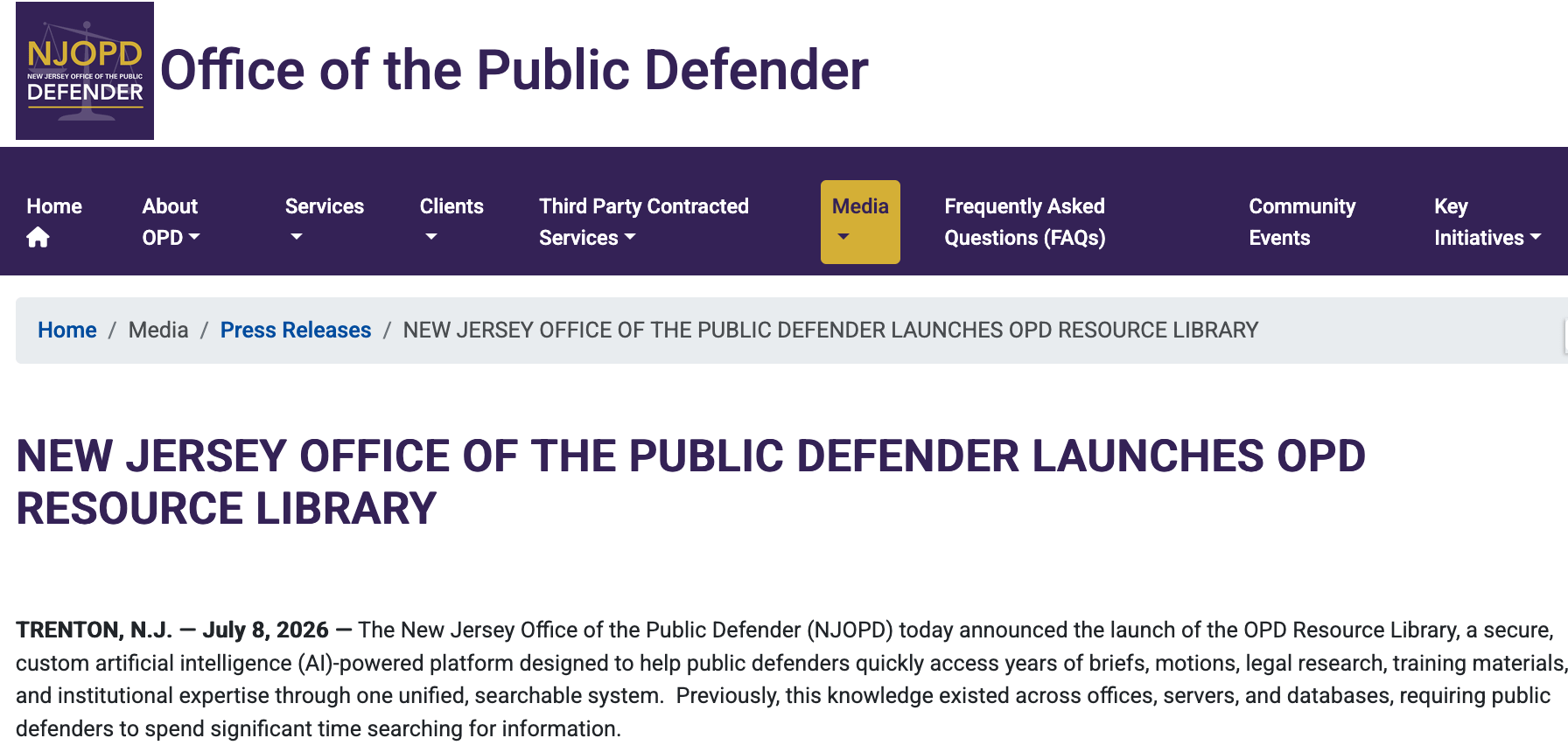
Last week we announced the launch of a new AI tool New Jersey Office of the Public Defender! AI can empower civil servants and improve public services, and this project provides a blueprint for doing so responsibly. Check out more info below.
The Challenge
Public defense is demanding work. Attorneys often manage large caseloads and face tight deadlines while striving to develop the strongest possible arguments for their clients. They regularly turn to colleagues to brainstorm and exchange knowledge: What has worked in court? What hasn’t? How has the law changed?
The New Jersey Office of the Public Defender (NJOPD) has an extensive collection of notes, memoranda, and past briefs containing valuable institutional knowledge. Until now, however, finding relevant information across these resources could be difficult and time-consuming—but essential for helping make the best case possible. Here’s an example of an attorney general directive, for example, that might be useful for a defender to keep track of:
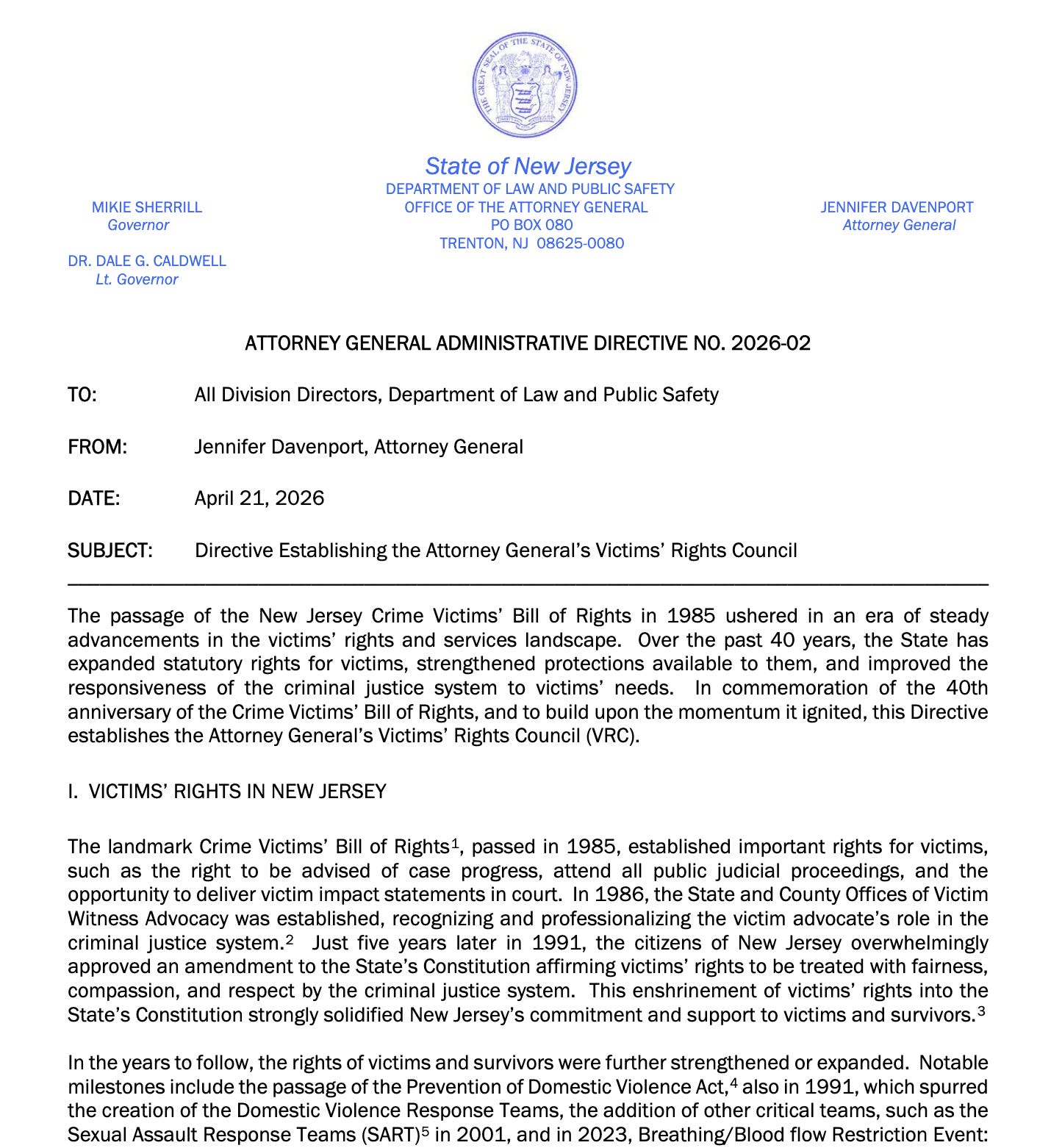
Examples of briefs at the appellate level can be found here on NJ’s official webpage, and AG directives can be found here.
This is a task well suited to AI: rapidly searching large volumes of information and surfacing the most relevant material. A centralized, AI-powered resource could help NJOPD share its institutional knowledge more efficiently and support attorneys as they develop legal arguments. That is what we set out to build.
The AI-powered OPD Resource Library
In a speech at the NJ AI Summit on April 11, 2024, then-Governor Phil Murphy announced his support for a new partnership between Princeton University and the New Jersey Office of the Public Defender (NJOPD). “Together, they are working to build an AI-powered resource that will help our state’s public defenders provide the best possible representation to our most vulnerable neighbors.”
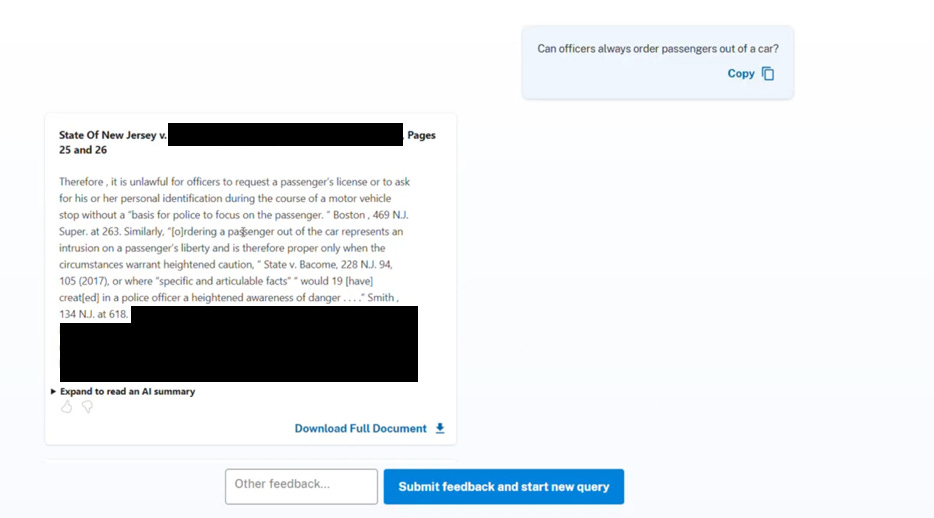
Through this partnership, we developed the AI-enabled OPD Resource Library, a search platform that gives employees rapid access to the office’s collective knowledge. In response to a legal question, it identifies relevant appellate briefs, internal documents, and public directives from a secure, closed collection.
The NJ AI Task Force Report describes the library as “an AI-powered tool designed to help public defenders efficiently draft legal briefs” by providing a repository of briefs, motions, and other documents that can serve as templates or references. Building on the office’s established practice of consulting prior work, the platform supports more efficient case preparation and greater consistency in legal arguments.
Speaking at the OECD Roundtable on Equal Access to Justice (2025), New Jersey Public Defender Jennifer Sellitti highlighted its impact: “Public defenders can now enter a legal question and receive content vetted by NJOPD experts. Our lawyers still exercise full professional judgment and verify all results, but the tool eliminates the most tedious part of brief writing. What once took hours – gathering the core legal arguments – now takes seconds.”
With support from the New Jersey Innovation Authority, the New Jersey Office of Information Technology, AWS engineers, and the NJOPD IT team, we deployed the Resource Library as a closed-universe application available to all NJOPD attorneys and staff.
Blueprint for responsible empowerment of public services
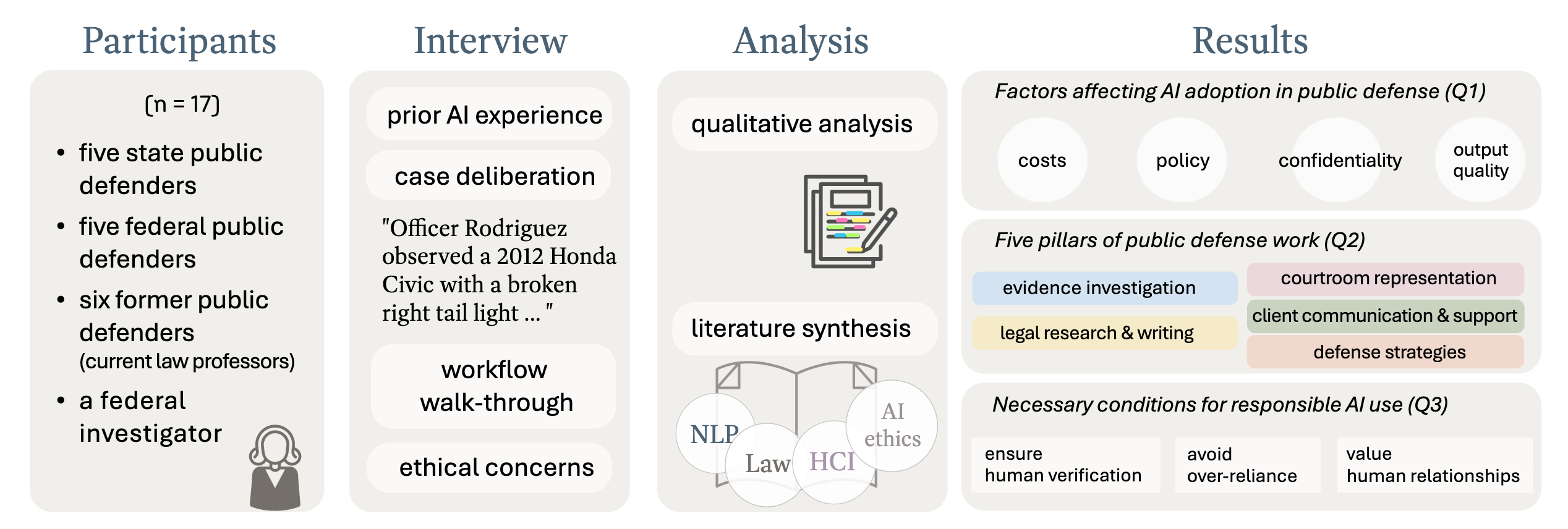
Our collaboration offers a blueprint for how AI can improve public services and empower public servants—when developed responsibly and in close partnership with the people who will use it. As part of this effort, we worked closely with NJOPD and interviewed public defenders across the country to identify best practices for deploying AI in public defense.
We conducted structured qualitative interviews with public defenders across the country to explore current needs, help inform best practices, and identify potential blue sky ideas for how to leverage AI for public defense. Participants emphasized that the most useful legal-research applications would provide high-level summaries and overviews, identify needle-in-a-haystack evidence, and offer starting points for determining the most relevant facts and ideas for a case. These are also among the reasons consulting past briefs has long been common practice within NJOPD.
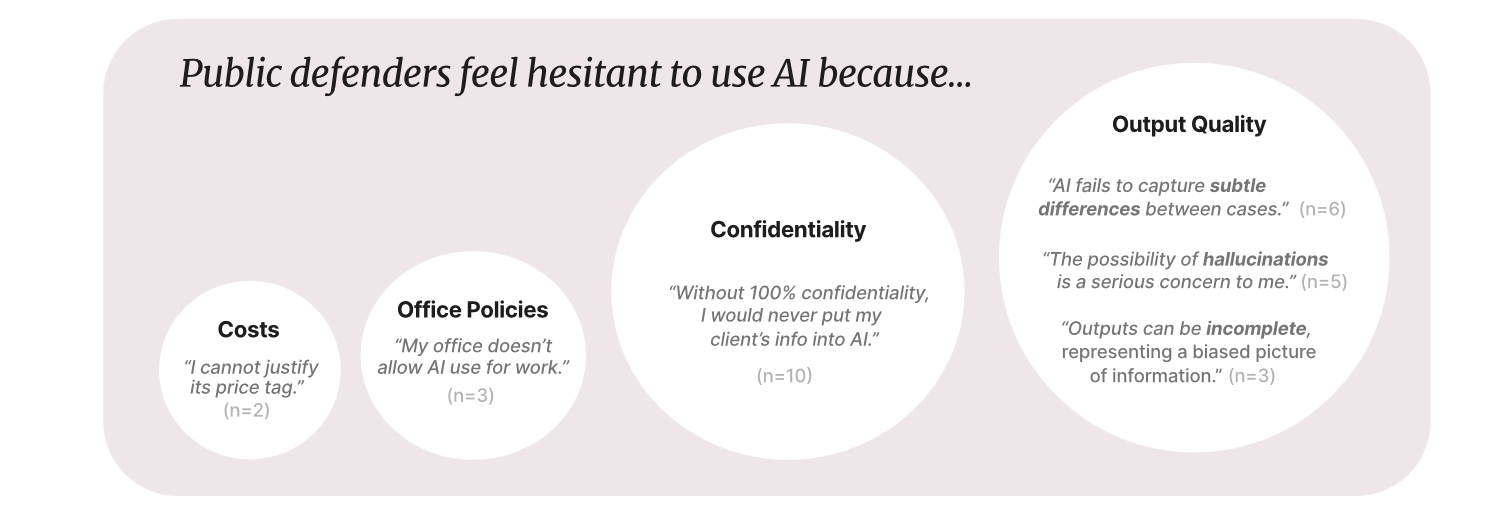
But participants also expressed their hesitancy in using AI, citing concerns about hallucinations, confidentiality, costs, or office policies:
In our collaboration with NJOPD, we wanted to identify the most responsible pathway forward for AI-assisted empowerment of public defense while mitigating these downsides. This led to focusing on extractive-first, rather than generative-first, solutions as a first pass. We use foundation models to retrieve the most relevant passages in past briefs, memos, and guidance throughout NJOPD and highlight those to the user.
We also provide optional AI summaries to help them get situated in the facts of the case. Importantly, to reduce the risk of misinterpretation of the law, our summaries focus on the facts of the case, not any legal holding.
At the OECD Roundtable, Sellitti further argued: “Technology will not define the future of public defense. Our lawyers will.” In our interviews, one participant said that “clients have a right to counsel, not to machines.” We believe that AI for public defense should follow such humanistic principles, and we design our AI tools accordingly.
Making open-weight models better for legal retrieval
To address confidentiality concerns, our system uses only open-weight models on a government-managed AWS environment. Our first pass showed that off-the-shelf models and systems don’t work so well. To address this, we collected a representative dataset of NJOPD workflow queries, contributed and annotated by Appellate Division public defenders, to whom we are immensely grateful.
We found that these queries differ substantially from those in existing legal-retrieval benchmarks. We also found that many small embedding models perform poorly on public defenders’ queries.
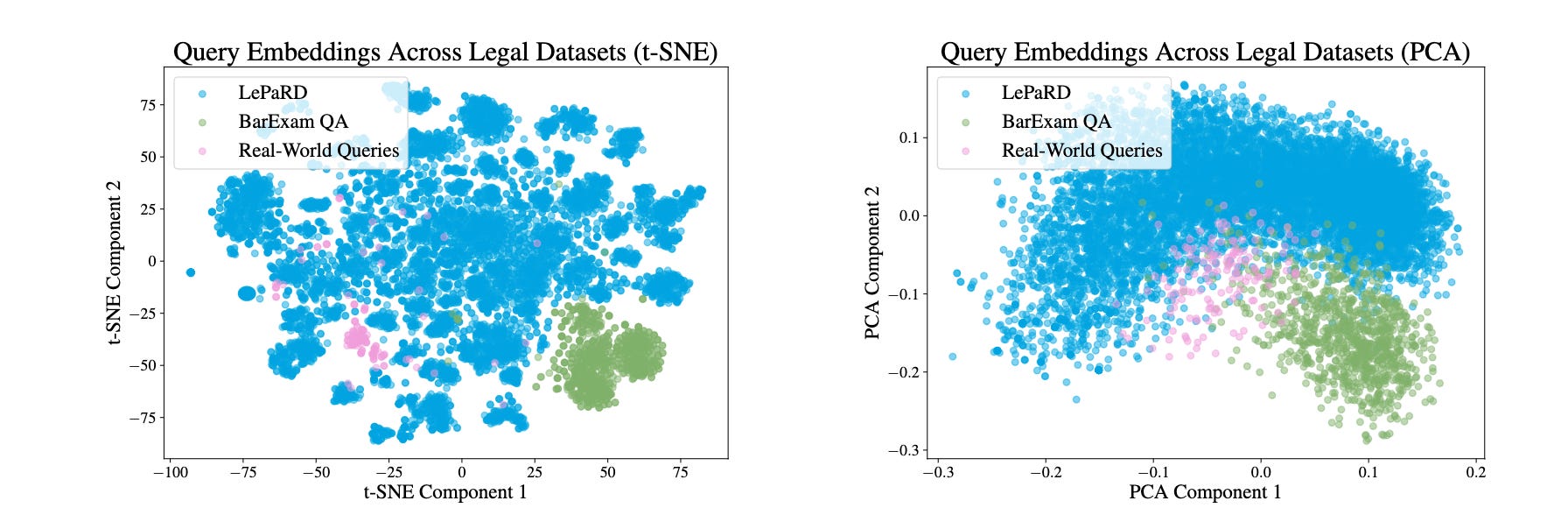
Using this as a reference, we created a representative open dataset, which can be found on HuggingFace here. We hope people will use it as a resource and benchmark for improving retrieval models!
Concluding Thoughts
By combining public defenders’ on-the-ground expertise with AI expertise from institutions such as Princeton, we can build and deploy more capable, responsible systems for the public good while advancing research in the process.
At the Princeton Polaris Lab, we’re excited about building advanced frontier systems for public good—particularly in important strategic decision-making settings like NJOPD. If you’re interested in working together, please don’t hesitate to reach out!
For further reading, check out:
A preprint Legal Retrieval for Public Defenders, outlining our approach to training AI models for responsible deployment in public defense.
A manuscript about Public Defenders’ Perspectives on AI Adoption (FAccT 2026).
This work would not have happened but for the extraordinary efforts of Princeton post-doctoral scholar Dominik Stammbach. We would like to thank all our partners at the New Jersey Office of the Public Defender, most importantly Jennifer Perez, Alison Perrone, Brandon Rios and Ronald Wildmann, without whom this would not have been possible. We also thank Walker Gosrich, who has supported the project from the start, anonymous interview participants who took part in our qualitative research, and everybody from the NJ Innovation Authority, New Jersey Office of Information Technology and AWS.