

NeurIPS has announced that it will not accept or publish submissions from OFAC-sanctioned institutions. The handbook now states that “providing ‘services’ (which includes peer review, editing, and publishing) to individuals representing sanctioned institutions is prohibited.”
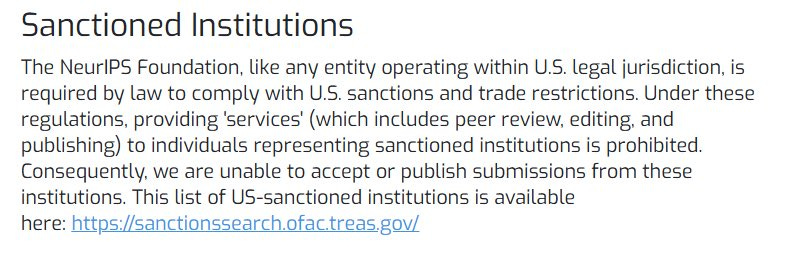
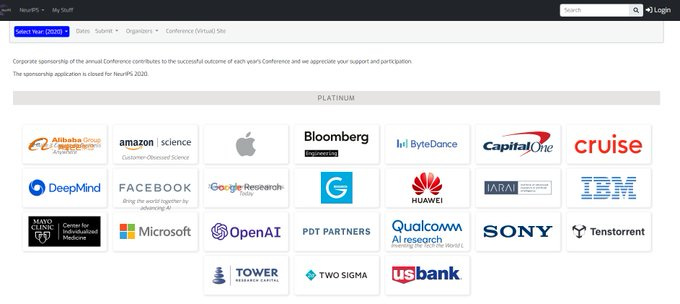
The linked list includes a long-time sponsor of NeurIPS, Huawei!
[Though technically Huawei is “sanctioned” under an EO and is not on the SDN list, so there are fewer restrictions on US entities/persons dealing with Huawei. NeurIPS has since clarified that they only apply this policy to SDN sanctioned individuals/entities only, which makes sense.]
But apparently this policy is also not new. Here’s a post from Russian researchers receiving a desk reject due to the same policy last year.
![r/MachineLearning - [D] NeurIPS: rejecting papers from sanctioned affiliations mid-process](https://substackcdn.com/image/fetch/$s_!rb9L!,f_auto,q_auto:good,fl_progressive:steep/https%3A%2F%2Fsubstack-post-media.s3.amazonaws.com%2Fpublic%2Fimages%2Fcafaea86-b06d-48e2-8995-33996473b28c_1280x321.jpeg "r/MachineLearning - [D] NeurIPS: rejecting papers from sanctioned affiliations mid-process")
The more recent bans have sparked outrage on X, with many researchers refusing to review or AC for the conference. And NeurIPS noted that it is a legal requirement, not a choice on their part, and it is currently getting legal advice on the matter.

A few folks have been asking how is this possible in the United States given the First Amendment? Is peer review a “service” the government can prohibit? Or is it a First Amendment-protected activity?
As usual when my AI and law worlds collide, the answer is more complicated than either side seems to think. (Though, again, this isn’t legal advice, just a legal academic take and some general background.)
tldr; If NeurIPS decided to NOT have this policy and the government decided to enforce it, it’s a sufficiently grey area issue that I think we could see a case like NeurIPS v. US Treasury at the Supreme Court!
The case for protection
There’s certainly a case to be made, where NeurIPS could potentially argue that review/publishing would receive First Amendment protections. Just last year, in Foundation for Global Political Exchange v. Treasury (settled Nov. 2024) a similar issue came up.
The [Foundation for Global Political Exchange] is a U.S. non-profit organization that promotes professional and academic enrichment through convenings in the Middle East and North Africa called “Exchanges.” Each Exchange involves small-group, immersive dialogues that allow participants—including journalists, human rights advocates, and government officials—to engage with and question thirty to forty of the key stakeholders from across the political landscape of a subject country. In advance of the Foundation’s January 2023 Beirut Exchange, OFAC informed the Foundation that it could not lawfully include in these discussions five prominent political figures who were designated under a U.S. sanctions regime or were members of a designated organization.
OFAC reversed course after the Knight First Amendment Institute sued, conceding through a settlement that including sanctioned individuals as conference speakers was not a prohibited “service” — so long as no financial transactions, lodging, or other things of value were provided.
The Berman Amendment (1988) and the Free Trade in Ideas Act (1994) explicitly exempt “information and informational materials, including but not limited to, publications” from the President’s sanctions authority under IEEPA. When OFAC tried to regulate scholarly editing in the early 2000s, IEEE and others pushed back. OFAC backed down in 2004, confirming that peer review and copy editing were permissible.
More generally, Lamont v. Postmaster General (1965) established that U.S. citizens have a First Amendment right to receive speech from abroad — in that case, communist magazines from China. Brennan’s concurrence called the right to receive publications “a fundamental right.” Miami Herald v. Tornillo (1974) held that editorial decisions about what to publish are exercises of protected editorial judgment. Peer review is the academic analog.
But national security caselaw cuts the other way
Unfortunately for First Amendment fans, courts have built a body of doctrine that defers heavily to the government when it invokes national security, even when the regulated activity is speech or expressive.
The big one is Holder v. Humanitarian Law Project (2010). The Supreme Court upheld 6-3 the ban on providing “material support” to designated foreign terrorist organizations — including “training,” “expert advice,” and “service” — even when directed at teaching nonviolent conflict resolution. The Court deferred to Congress’s finding that even peaceful support “frees up resources” for illicit activities.
For more on the history of OFAC and scholarly publishing, see the Knight Institute’s analysis of the material support law’s chilling effect, and this NYU Law Review note on how OFAC’s regulations restrain First Amendment rights. But Holder has broadly created problems since 2010 like this. And it is very possible that it could be used as precedent against NeurIPS in this case.
Two things I think the community is missing
Scope. There seems to be a misunderstanding about who this applies to. The OFAC SDN list targets specific institutions, not entire countries. This likely affects a few entities on the list, many (most?) of which are unlikely to submit to NeurIPS. It does not cover all researchers from any particular country. Chinese universities are generally on BIS export control lists, not OFAC sanctions, and the legal frameworks are distinct.
The speech/services line. This is what I find most interesting. Clearly, conference organizers received legal advice that there’s a fine line and they might be providing services.


The GPE settlement does draw a line saying speech-related activities are permissible, but it’s unclear at what point that crosses into services that are sanctionable. Even in the GPE settlement letter, OFAC wrote:

If NeurIPS only published papers, the 1A argument is probably stronger. The Berman Amendment and OFAC’s own 2004 ruling protect scholarly publishing. But NeurIPS also provides conference services — venue access, registration, networking events, lodging coordination. For sanctioned entities, those start to look like the kind of economic benefits OFAC can regulate. The problem for NeurIPS actually gets harder at the venue where there would be more opportunities for NeurIPS (and potentially sponsors of events) to cross over into a much more problematic territory. Think about if, e.g., someone wins a GPU, gets travel covered by a workshop, or is hosted at a company event.
At the end of the day
It will be interesting to see what NeurIPS does. But it’s important to understand that legal landscape of First Amendment law right now to better engage with the issue. Hopefully this is helpful background.