

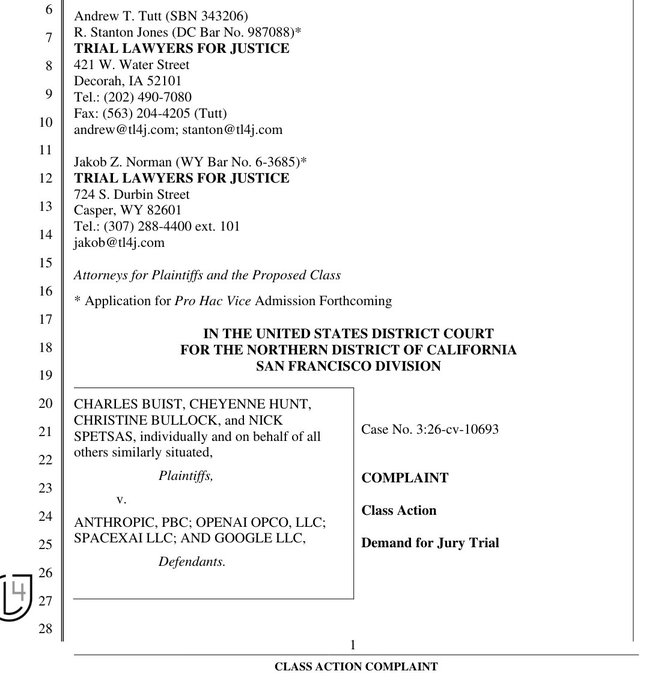
If you’ve been following the movement to “pace the frontier”—and are familiar with antitrust law—you probably were expecting a lawsuit to come if an agreement was ever made. In fact, AI companies had reportedly already been citing antitrust concerns to the government for why they couldn’t coordinate on pacing the frontier. Well, the issues became a bit more salient with a filing in the Northern District of California. Here’s perhaps the forceful (somewhat e/acc) point of the plaintiffs:
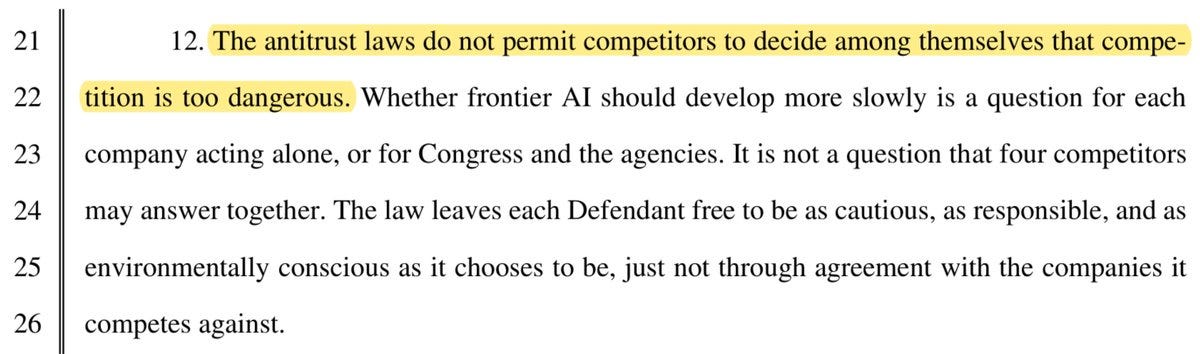
Below are some personal thoughts and a potential path forward—but it requires executive-branch participation.
The alleged agreement
I’m not sure that the public statements and private meetings alleged in the complaint establish an agreement to actually pace the frontier—and likely there has probably not even been a slowdown as of yet.
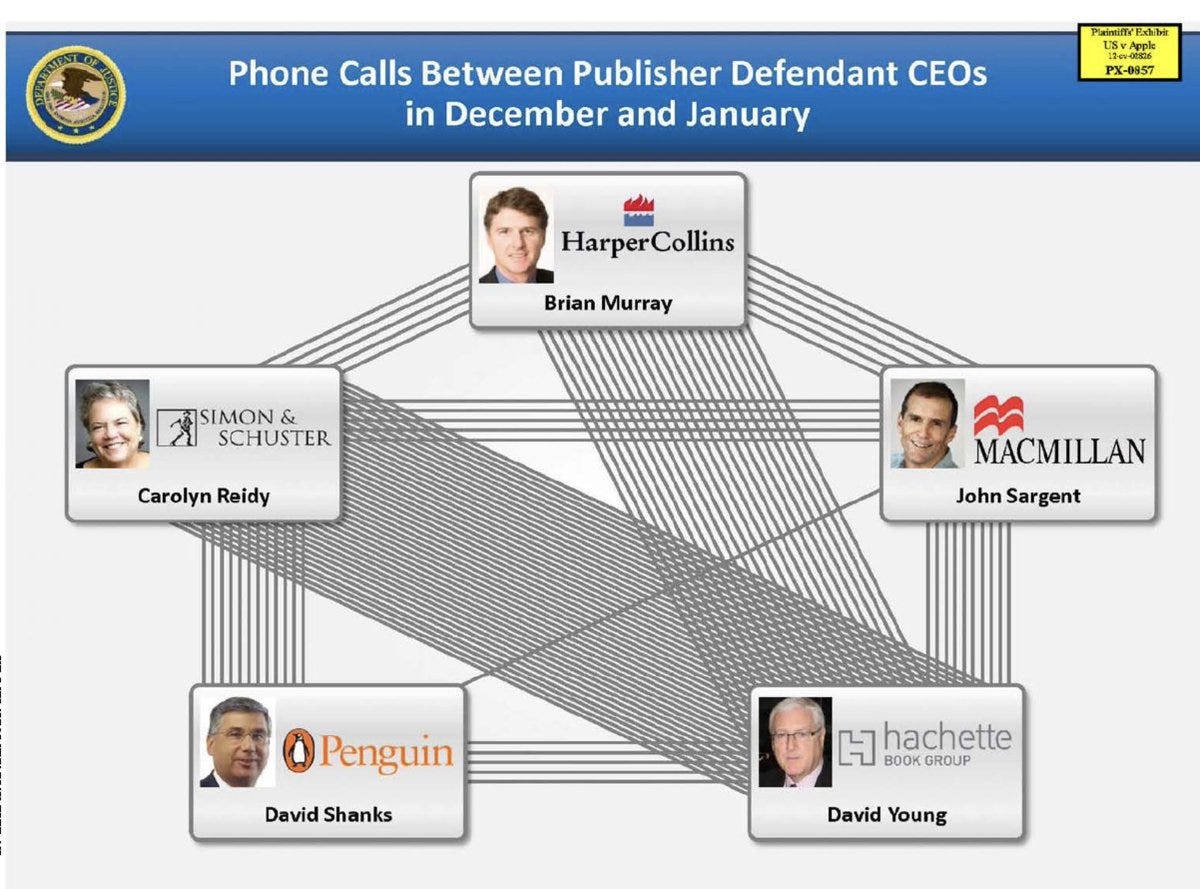
But in the Apple e-books antitrust case I always teach in my AI Law class, there’s this classic phone call chain graphic that DOJ used as evidence (see image below). One could imagine similar communications becoming relevant here, though what was actually agreed would be the key question.
The safety defense
The coordination problem does present a real challenge under antitrust law, in my personal opinion. In National Society of Professional Engineers, SCOTUS rejected arguments from engineers defending restrictions on competitive bidding on the grounds that competition could produce unsafe work.
Here’s a quote from the Court’s syllabus:
“Petitioner’s affirmative defense confirms rather than refutes the anticompetitive purpose and effect of its canon, and its attempt to justify, under the Rule of Reason, the restraint on competition imposed by the canon on the basis of the potential threat that competition poses to the public safety and the ethics of the engineering profession is nothing less than a frontal assault on the basic policy of the Sherman Act.”
Now, of course, that doesn’t make safety collaboration categorically unlawful. More recently, Epic v. Apple recognized security and privacy improvements as potential procompetitive benefits. As the Ninth Circuit explained:
“But, throughout the record, Apple makes clear that by improving security and privacy features, it is tapping into consumer demand and differentiating its products from those of its competitors—goals that are plainly procompetitive rationales.”
But that’s a very different context. The courts may choose to distinguish this case.
The remedies
From a practical/remedies perspective, I’m not sure that there’s much risk this early. It’s not clear to me how much development has actually slowed because of the alleged agreement, and establishing the resulting loss in subscription value would be difficult. If there will be action against the companies, an injunction is most immediate and likely. Companies can of course choose to unilaterally pace the frontier, but it’ll be harder to do that across multiple companies if an injunction is in place. Nonetheless, it certainly won’t help informal coordination on pacing the frontier.
A path through the DPA
There’s a solution: the President could potentially invoke §708 of Title VII of the Defense Production Act. Section 708 allows the President or authorized officials to sponsor voluntary industry agreements addressing national-defense needs, with a limited antitrust defense for qualifying conduct under approved and actively supervised arrangements.
Upon finding that conditions exist which may pose a direct threat to the national defense or its preparedness programs, the President may consult with representatives of industry, business, financing, agriculture, labor, and other interests in order to provide for the making by such persons, with the approval of the President, of voluntary agreements and plans of action to help provide for the national defense.
—Defense Production Act §708(c)(1), 50 U.S.C. §4558(c)(1)
This could provide a framework for coordination on safety, potentially including some pacing measures. (Of course that would require satisfying the statute’s requirements, but I think they could be satisfied.)
Of course that seems unlikely given the President’s recent statements on the matter.
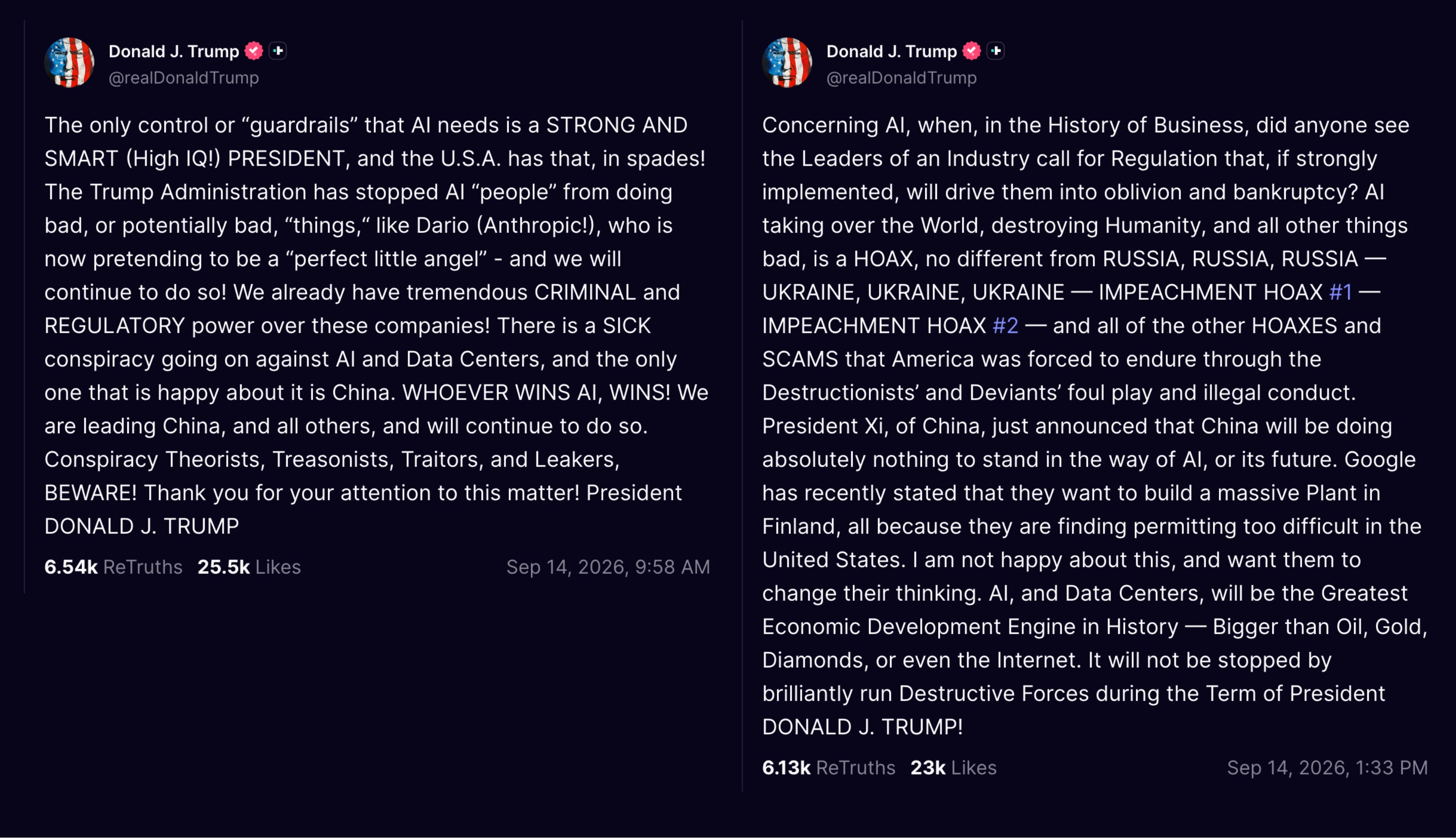
But you never know. It’s early, and the President’s new creation of an “AI Force” could be a pathway for invoking the DPA for this purpose.
Thanks for reading Trials & Errors! Subscribe for free to receive new posts and support my work. All opinions here are my own and not of my employer. Not should they be construed to be legal advice in any way.